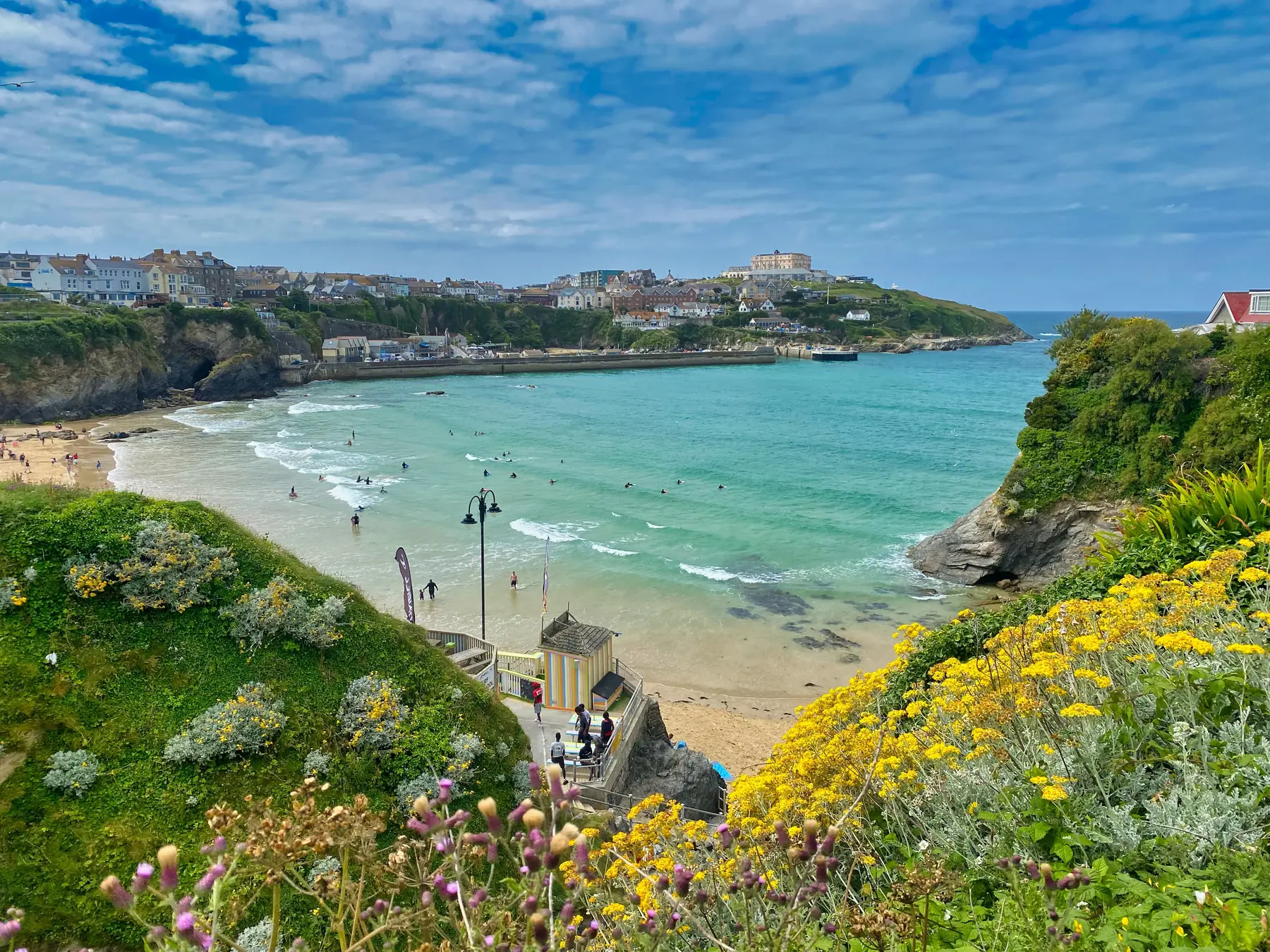
Newquay is the most family-oriented resort in Cornwall, and it is not really close. There are more beaches within walking distance than anywhere else on the coast, a zoo and an aquarium in the middle of the town, a miniature railway and an adventure park inland, and a surf industry that has been teaching children to stand on a board for fifty years.
The town’s older reputation as a stag and hen destination has faded considerably, and the summer trade is now overwhelmingly families. There is still a lively town centre at night in season, which is worth knowing when choosing where to stay.
Half a kilometre from the centre, in Trenance Gardens. It is the largest zoo in Cornwall, with around a thousand animals, and it is compact enough to do properly in half a day without anyone being carried. Lions, monkeys, penguins, a dragon maze and a good deal of conservation work with endangered species. See our Newquay Zoo page.
On Towan Beach, with a walk-through tunnel, tropical tanks, rays and octopus, and a strong local-species section that connects directly to what is in the rock pools outside. An hour and a half, indoors, and right next to the beach.
In the valley below the zoo: a boating lake with pedalos and rowing boats, formal gardens, a play area and a café. Free to walk in, cheap to boat on, and the natural companion to a zoo visit.
Pirate’s Quest on St Michael’s Road is an indoor adventure golf and pirate attraction. The seafront and Towan Beach have the usual arcades, and Towan Beach itself has the famous house on an island connected by a private suspension bridge.
Newquay has more than a dozen beaches. The short version for families:
Towan — right in the town, sheltered, sandy, tidal pool at low water. Best for toddlers.
Great Western and Tolcarne — town beaches below the cliffs, sandy, with steps down and lifeguards in season.
Lusty Glaze — a private cove reached by a long staircase, with a beach restaurant, activities and a very sheltered feel. Charges apply at times.
Fistral — the surf beach. Big waves, strong rips, and the place for lessons rather than paddling.
Crantock — across the Gannel, wide, National Trust, with an estuary running through it. Excellent for older children; watch the river channel.
Watergate Bay — three kilometres of sand north-east, with space for everything.
Polly Joke — no facilities, no road, no lifeguards. A walk and a picnic rather than a beach day.
Our beaches guide has the full list.
Newquay calls itself the surf capital of Britain and the teaching infrastructure reflects it. Several surf schools run children’s lessons from about age eight, in groups, with wetsuits and soft boards, on the beaches where the conditions suit beginners rather than on the biggest waves.
It is one of the genuinely good things to do here with children of the right age, and the instructors are used to complete novices. Our surfing guide covers who teaches where.
For younger children, bodyboarding in the shallows on a supervised beach does most of the same job.
Lappa Valley, five kilometres inland, is a fifteen-inch gauge steam railway running from Benny Halt to the old East Wheal Rose mine site, where there is a leisure area with boating, a maze, crazy golf and a second and third miniature railway. It is a full day for younger children and one of the best-value family attractions in Cornwall.
Camel Creek Family Adventure Park, thirteen kilometres north, has rides, animals and indoor play.
The Japanese Garden at St Mawgan, seven kilometres away, is small, beautiful and about twenty minutes of a child’s patience — but the village and the beach at Mawgan Porth make a good afternoon.
Trerice, four kilometres inland, is a small Tudor manor with an orchard and lawn games, National Trust, and works better with children than a grand house does.
Blue Reef Aquarium and Pirate’s Quest are the indoor options in the town. Newquay Zoo works in rain, on the grounds that the animals are outside anyway. Beyond the town, the Eden Project near St Austell is forty minutes away and is the definitive Cornish wet-day destination. Our wet weather guide has more.
Getting here. Newquay has its own station, three hundred metres from the centre, at the end of a branch line from Par. Most journeys change at Par; direct trains from London Paddington run in summer but are thin and seasonal, so plan on the change outside those months. Cornwall Airport Newquay is a few kilometres away.
Parking. Free at Crantock, Pentire Headland, Mount Wise, Fistral, Manor and Tregunnel Hill. The beach car parks fill early in August.
Tides matter here more than in most resorts. Several beaches shrink or disappear at high water, and the Gannel crossings only work around low tide.
Rips. Atlantic beaches, real rip currents. Swim between the flags and take the lifeguards seriously.
A beach and town day. Morning at Towan while the tide is out, with the tidal pool and the rock pools; the Blue Reef Aquarium next door when everyone has had enough sand; lunch on the harbour; then the zoo and the boating lake at Trenance in the afternoon. None of it is more than a quarter of an hour on foot from the rest.
A big beach day. Drive or bus out to Watergate Bay for the morning — three kilometres of sand and space for everything — with a surf lesson booked for whoever is old enough. Lunch at the beach. Then either stay put or move south to Crantock for the afternoon, timing the Gannel crossing or going round by road.
Under five: Towan, the boating lake, the zoo, Trenance Gardens, rock pools at low tide.
Five to eleven: the sweet spot. Surf lessons from eight, the aquarium, Lappa Valley for a full day, Camel Creek, bodyboarding on the town beaches.
Teenagers: surfing properly, coasteering, sea kayaking, the Camel Trail by bike from Padstow, and Boardmasters in August if you can face the crowds.
Three things catch families out here, and all three are about water.
Rip currents. These are Atlantic beaches and the currents are real. Swim between the red-and-yellow flags on lifeguarded beaches, and treat unpatrolled beaches — Polly Joke among them — as swimming at your own risk.
The Gannel. The tidal crossings to Crantock work only around low water and the tide comes in fast. Check the times before you walk over, and know where the road bridge is.
Tide-cut coves. Little Fistral, parts of Crantock and the beaches below Bedruthan all get cut off. A tide table costs nothing and changes the day.
The beaches, the headlands, the Huer’s Hut, Trenance Gardens, the coast path and the rock pools are all free, and several of the best beaches have free parking. The zoo, the aquarium, Lappa Valley and Camel Creek all charge, and a family doing all four in a week will spend a fair amount.
The sensible pattern is one paid day in three, with the rest on the sand. Our free things to do guide has the full list.
The beaches, first. After that: the zoo and the aquarium in the town, and Lappa Valley inland for a full day.
Towan, which is sheltered and right in the town, with a tidal pool at low water.
Most Newquay surf schools take children from about eight in group lessons, with wetsuits and boards provided.
Much less than it was. The summer trade is overwhelmingly families now, though the town centre is still lively at night in season.
Five or six. There are more beaches here than you can do in a week.