Crantock is a coastal civil parish and village on the far bank of the tidal River Gannel, which forms the boundary between the parish of Newquay and this one. In the 2021 census it held 925 people in 422 households, so it is small: an old core of houses around a church, a wide dune-backed beach below.
The straight-line distance is 2.6 km. On a map that is almost nothing. On the ground the estuary is in the way, and how you cross it — the seasonal ferry, or the long way round by road — is most of what turns this into an outing rather than a walk along the front.
Large parts of the parish belong to the National Trust, including West Pentire headland, a Site of Special Scientific Interest noted for its wild flowers and rare plants.
Crantock Beach is backed by sand dunes and, like several other sandy beaches around Newquay, is popular for surfing. It carries 4.8 from 2,609 Google reviews, and appears again as a National Trust listing at 4.8 from 863.
It is not a fixed beach. In 2014 storms brought down a retaining wall and the Gannel changed course; the river now meanders across the sand, eroding the base of the dunes and leaving them at risk of collapse. In June 2023 part of the beach was closed after a section of the dunes, 65ft (20m) high, came down. Since January 2016 the estuary, including the beach as far as the tidal limit, has been inside the Newquay and the Gannel Marine Conservation Zone.
Tide decides what you find. A visitor in July 2026 wrote, “From 4 p.m. there is a very low tide, leaving warm, shallow water without current flow.” That was one afternoon rather than a rule, but the shape of it holds: a wide, shallow beach at low water, much less at high.
Parking is the recurring complaint. There are car parks at Crantock Beach and West Pentire, and both fill. The same July 2026 visitor wrote, “Two parking lots, both hard to find a free spot, take your time but it is worth waiting.” A visitor in August 2026 put it shorter: “Lovely family and dog friendly beach. Not too many parking spaces.”
There is little down at the sand itself. A visitor in June 2026 wished somebody would “stick a pub and some more food options down there”, while rating the Cornish pasty bought from the hut on the beach among the best they had had.
At the left-hand side of the beach, low tide uncovers a carving cut into rock inside a cave — a woman’s face, and a verse beginning “Mar not my face but let me be, Secure in this lone cave by the sea”.
The story attached to it is that in the early 20th century a woman riding along the beach was cut off by the tide and swept away and drowned with her horse; her lover cut the poem, her portrait and the horse into the rock. The work is said to be that of a local man, Joseph Prater, but it is unclear who he was: brothers Joseph and William Prater rented studio huts on the cliff top above the beach, and another candidate is Joseph Henry Prater, a dairyman on the farm just above the cave. The woman is unidentified, though a journalist, Ethel de Medina Greenstreet née Spender, drowned here in 1904. One source credits the horse to a different man, James Dyer, working in the 1940s.
The carving is real; the attribution is not. It carries its own warning too, appearing only at low tide, in a cave, on the beach where the tide is what kills the woman in the story.
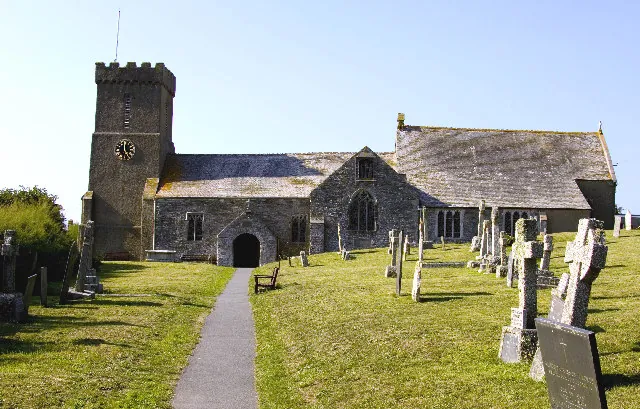
In 460 a group of Celtic missionaries founded an oratory here. The older part of the village stands around its parish church, dedicated to St Carantoc, founder of the village; the parish was once called Langurroc, “the dwelling of monks”, and a Langurroc Road survives. Langurroc itself is said locally to have been buried in a sandstorm, and may lie under the dunes behind the beach.
Domesday records a collegiate church at Crantock, refounded in 1236 and dissolved in 1549 during the Reformation. St Carantoc’s Church was founded in Norman times and was originally cruciform, then rebuilt in the 14th and 15th centuries; E. H. Sedding restored it between 1899 and 1902 and is buried in the churchyard. The font is Norman and the rood screen much restored. The ground is older still than the church: the Cornwall Archaeological Unit dated human activity around the Gannel to the Mesolithic.
The village is a working one rather than a set: a hall rebuilt three times larger with National Lottery money, a street fair called the Crantock Summer Fiesta, and a “big bale push” in which locals roll straw cylinders around closed roads, raising over £50,000 for charity.
The South West Coast Path runs along the whole western side of the parish. From Crantock it leads to Porth Joke, a sandy cove also known as Polly Joke, from the Cornish porth lojowek, “cove abounding in vegetation”. It is surrounded entirely by National Trust land and virtually unchanged. Further on the path reaches the village of Holywell and the larger sands of Holywell Bay, 4.8 from 1,107 Google reviews, where a visitor in August 2025 warned that the “Car park fills up quite quickly by around 1pm.”
The crossing is the point. The Gannel is tidal, and ferries run on a seasonal basis from Fern Pit to Crantock Beach — a short trip over the water in place of a detour inland, though not one to count on out of season.
By road, the village is reached from the A3075 via the junction at Trevemper. That drive ends at the two car parks above, which is where a hot afternoon is most likely to go wrong.
No bus route between Newquay and Crantock is established in the sources behind this page, and no signed walking or cycling route either, though Komoot’s catalogue of routes around Newquay does take in the Gannel estuary. Newquay’s own buses leave from Manor Road bus station, 0.7 km from the centre. Two large holiday parks sit on the Crantock side, Parkdean Resorts Crantock Beach and Trevella, for anyone minded to stay over there instead.
The village and what is around it, at walking scale.
Open any of them in Google Maps for directions and current opening.
Attractions, prices and availability in Newquay
These come from GetYourGuide's booking widget, which sets their cookies in your browser. Consent to load it and see the attractions and prices.
Background on Crantock draws on its Wikipedia article, text there being available under CC BY-SA 4.0.