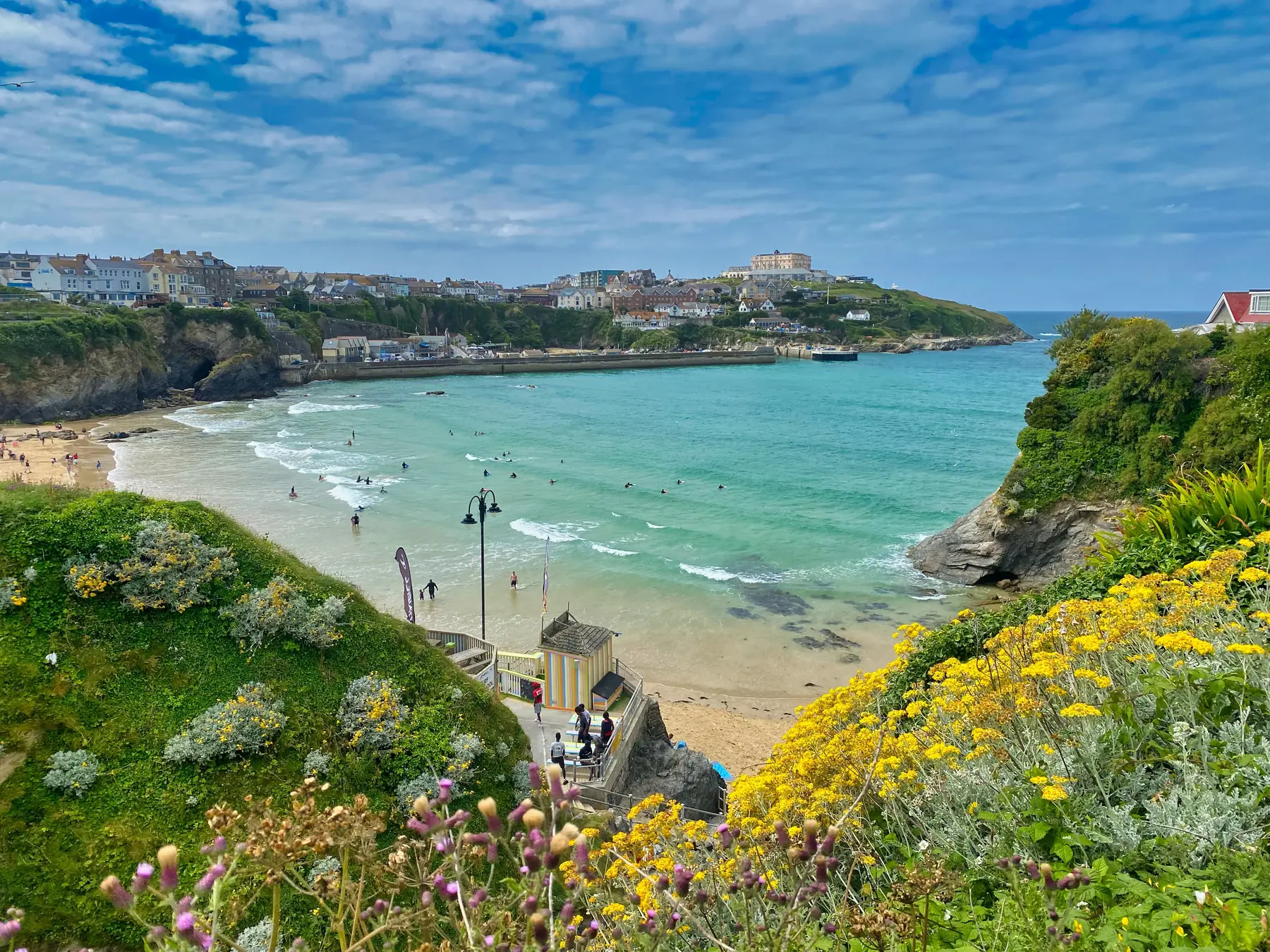
No other town in Britain has this many good beaches within walking distance. Newquay sits on a headland with sand on three sides of it, and between Watergate Bay in the north-east and Holywell in the south-west there are eleven beaches worth a visit, most of them within a few kilometres of the town centre.
They are not interchangeable. Some are sheltered town coves reached by steps; one is a serious surf beach; one is cut in half by a tidal estuary; one has no road to it at all. This guide sorts them out.
Two things govern all of them. Tides — several shrink dramatically or disappear at high water. And rips — these are Atlantic beaches with real currents, and the lifeguard flags matter.
In the town centre. The most sheltered of the lot, reached from the harbour end, with a tidal pool at low water and the famous house on an island connected to the mainland by a private suspension bridge. It is the best beach here for toddlers, and the aquarium is on it.
Four hundred metres from the station. A wide sandy beach below the cliffs, named for the railway that made the town, with steps down and lifeguards in season. It joins Towan and Tolcarne at low tide, which effectively gives you a kilometre of continuous sand.
Below Narrowcliff. Sandy, steeply cliffed, with a beach hotel and café. Popular with bodyboarders and quieter than Great Western.
A kilometre and a half east. A privately owned cove reached down a long wooden staircase, with a restaurant and bar on the sand, live music in summer and an activity centre running abseiling and zip lines. It is sheltered, dramatic and slightly theatrical, and charges apply at times. The Cornish name means green grazing place. See our Lusty Glaze page.
Across Towan Head, twenty minutes from the centre. The best-known surf beach in Britain and the reason Newquay is what it is. A broad west-facing bay that picks up Atlantic swell from every direction, with a reef break — the Cribbar — off the headland that produces genuinely large waves a few times a year.
Fistral has surf schools, board hire, a large car park, the International Surfing Centre with restaurants above the beach, and lifeguards in season. It hosts the professional surf competition at Boardmasters in August.
It is not a paddling beach. The rips are real, the waves are powerful, and the flags are there for a reason. Our surfing guide has more.
Round the northern end of Fistral under the headland. Small, rocky, and cut off at high tide — worth knowing before you settle on it.
Five kilometres north-east. Three kilometres of continuous sand below high cliffs, with a beach hotel, restaurants, watersports and enough space that it never feels full even in August. It is the best all-round beach near Newquay and it holds the Boardmasters music festival.
Three kilometres south-west across the estuary. National Trust, with free parking above it, and one of the finest beaches in Cornwall — a wide bowl of sand with dunes behind and the Gannel running out through it.
The river channel is the thing to watch: it is deep and it moves fast on an ebbing tide, and it is where the trouble happens on this beach. Swim in the sea, not the channel.
Getting there from Newquay means the seasonal footbridges or the tidal crossing at low water, the summer ferry, or the road round by Trevemper.
Beyond Crantock, on foot only. Properly called Porth Joke, a small undeveloped cove with no road, no facilities and no lifeguards. It is a twenty-minute walk from the nearest parking and it is the quietest good beach in the area. Take everything with you.
Eight kilometres south-west. Big dunes, a long beach, and the two rocks offshore that appeared in the Poldark titles. There is a village, a car park and a shop.
Ten kilometres north-east. A sandy cove at the mouth of a valley, with a stream, a couple of restaurants and a family feel. Quieter than Watergate.
Ten kilometres south-west. Five kilometres of sand at low tide, a beach bar built into the rocks at the northern end, and dunes running inland. One of the great Cornish beaches.
Toddlers: Towan, for shelter and the tidal pool.
A general family day: Watergate Bay or Crantock, for space.
Surfing: Fistral for the waves, Watergate for lessons, Towan and Great Western for absolute beginners on a small day.
Rock pooling: Towan and Little Fistral at low tide.
Getting away from everyone: Polly Joke.
Eating on the sand: Lusty Glaze or Watergate Bay.
A walk rather than a beach day: Bedruthan, north-east, where you go for the stacks and the clifftop rather than the swimming.
These are Atlantic beaches. Rip currents are the main hazard and they are strongest at low tide and around river channels and reefs. The RNLI patrols the main beaches in season and the red and yellow flags mark the supervised area; swim between them.
If you are caught in a rip, do not swim against it — swim parallel to the beach until you are out of it, or float and raise an arm.
Several beaches — Little Fistral, parts of Crantock, the coves below Bedruthan — are cut off by the tide. Check the times.
Bedruthan beach is dangerous and swimming there is not advised at any state of tide.
Free parking at Crantock (National Trust), Pentire Headland, Fistral, Mount Wise, Manor, St Georges Road and Tregunnel Hill.
Dogs face seasonal restrictions on the main lifeguarded beaches through the summer, typically Easter to early October. Crantock, Polly Joke and the quieter beaches are generally more relaxed.
Wetsuits. The sea here is cold outside high summer, and even in August most people surf in a wetsuit. Hire is available everywhere.
Best time. Sea temperatures peak in late August and September, which is when Cornish people swim.
Because it catches people out every summer, and because it is the single most local piece of knowledge about Newquay’s beaches.
The Gannel is the tidal estuary that separates Newquay from Crantock. At low water it is a wide plain of sand with a river running through it, crossed by seasonal footbridges that are only usable for a few hours either side of low tide. At high water it is a creek several hundred metres across with no way over except the road bridge at Trevemper, which is a long way round.
There is also a summer ferry at the Fern Pit end and a tidal crossing at Penpol. All of them are tide-dependent.
The classic mistake is walking to Crantock at low water, spending four hours on the beach, and finding the bridges under water on the way back. Check the tide before you cross, and know where the road bridge is.
The same river creates the channel at the mouth of Crantock beach, which runs fast on an ebbing tide and is where the rescues on that beach happen. Swim in the sea, not the river.
Worth checking before you set out with one. Most of Newquay’s main lifeguarded beaches have seasonal dog restrictions, typically running from around Easter to the beginning of October, either banning dogs outright or restricting them to particular hours and sections. The rules are posted at the top of each beach and are the current authority.
Outside that season, the whole coast is effectively a dog beach and it is one of the best places in Britain to walk one. Crantock, Polly Joke, Holywell and the coast path between them are generally the most relaxed year-round.
Watergate Bay for space, Crantock for beauty, Fistral for surf, Towan for young children.
Fistral, with Watergate Bay the better option for lessons and Towan for absolute beginners on a small day.
The main ones are, in season — Fistral, Towan, Great Western, Tolcarne, Crantock, Watergate and Perranporth among them. Polly Joke is not.
Across the Gannel at low tide using the seasonal footbridges, or round by road. Check the tide before you rely on the crossing.
Polly Joke, a twenty-minute walk from the nearest parking, which is why it is the quietest.