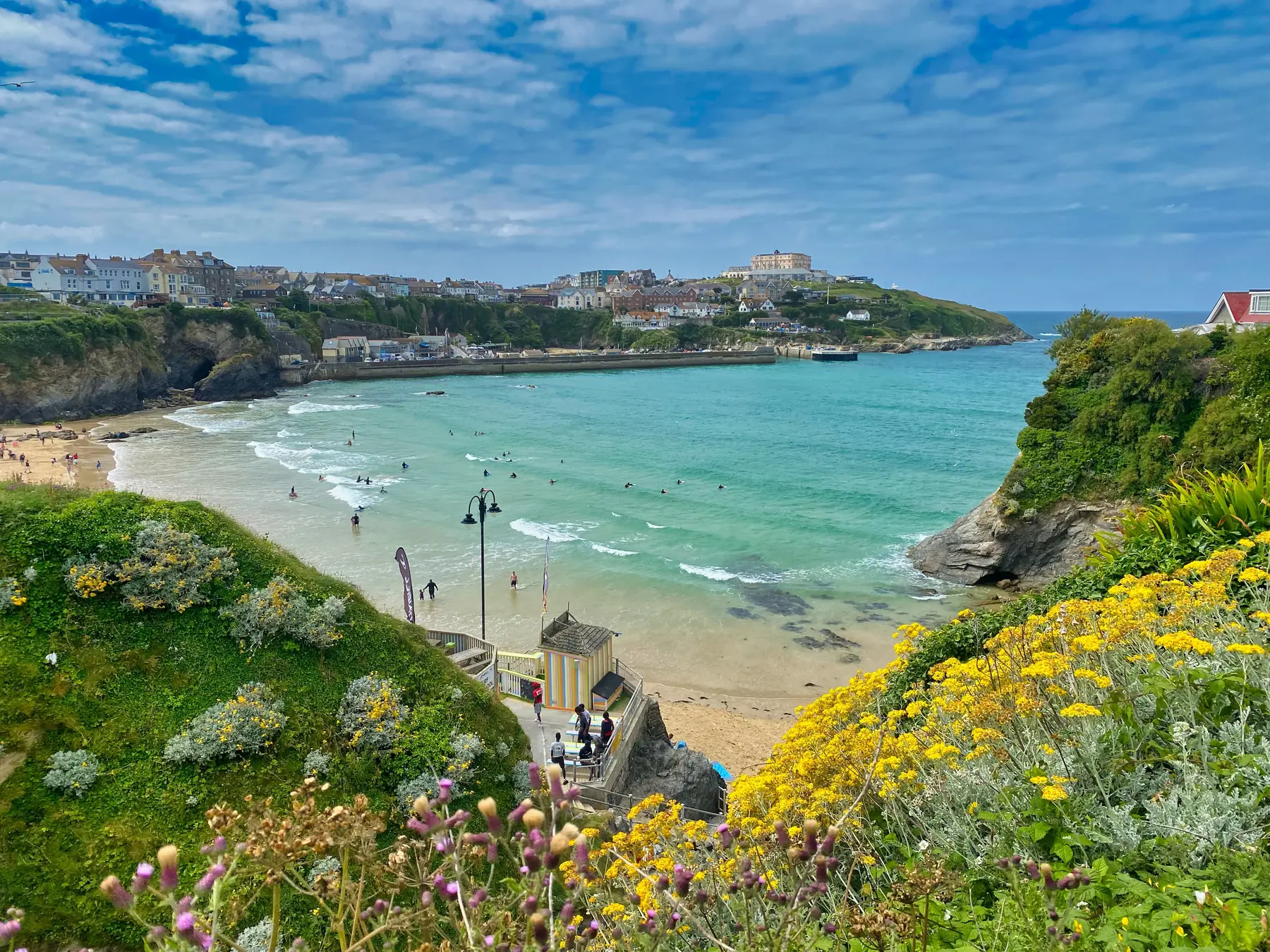
Newquay faces the Atlantic and takes what the Atlantic sends. That is the entire reason the surf is good, and it is also why a week here without rain would be unusual. Cornish weather moves fast — the peninsula is narrow and systems cross it quickly — so a wet morning frequently becomes a clear afternoon, and the local habit is to wait an hour rather than drive somewhere.
But you need a plan for the days that do not clear, and Newquay has more indoor options than most Cornish resorts because it is a full-sized town rather than a village.
On Towan Beach, and the obvious first answer. A walk-through underwater tunnel, tropical tanks, rays, octopus and a strong section on the species that live in the rock pools directly outside the building. An hour and a half, entirely indoors, and five minutes from the town centre.
Half a kilometre away in Trenance. It is outdoors, but the animals are unbothered by Cornish rain, there are indoor houses and a café, and the site is compact enough that you are never far from shelter. It is the largest zoo in Cornwall with around a thousand animals.
Indoor adventure golf and a pirate-themed attraction on St Michael’s Road. About an hour, and pitched at families.
Fore Street and the streets around it have surf shops, cafés and pubs in some quantity. It is not a great shopping town, but it is a perfectly good place to spend an hour out of the weather with a coffee, and the surf shops are genuinely useful if you have arrived without a wetsuit.
Five kilometres inland. The fifteen-inch gauge railway runs from Benny Halt to the East Wheal Rose mine site whatever the weather, and there is an indoor play area alongside the boating, the maze and the crazy golf. It is a better wet-day option than it sounds, though a good deal of it is outdoors.
Four kilometres inland at Kestle Mill. A small Elizabethan manor house with a barrel-vaulted plaster ceiling in the great chamber, a great hall with the original glass, and a National Trust café. It is entirely indoors and takes a comfortable two hours, and it is the best wet-weather visit close to Newquay for adults.
At St Mawgan, seven kilometres away. Small, and better in rain than in sun — Japanese gardens are designed around water and moss, and a wet afternoon suits it.
Forty minutes east near St Austell. Enormous biomes containing a rainforest and a Mediterranean climate, built in a former china clay pit. It is the definitive Cornish rainy-day destination for the straightforward reason that the whole point is being inside. Allow most of a day, and book ahead in the holidays.
On the same run, and largely outdoors — a Victorian estate garden lost for decades and restored. Better on a bright day.
Twenty kilometres south, half an hour by bus with services every thirty minutes. Cornwall’s only city: a Victorian Gothic cathedral, the Royal Cornwall Museum, Georgian streets and the best covered shopping in the county.
Wheal Coates and the St Agnes coast are outdoor, but the mining heritage sites inland — East Pool Mine at Pool with its working beam engines, and the museums around Redruth and Camborne — are indoor and are the best explanation you will get of what Cornwall actually was before tourism.
This is the Newquay answer, and it is a good one. The town’s activity operators run surf lessons, coasteering, sea kayaking, paddleboarding and wave-runner safaris in weather that would keep sunbathers indoors, on the entirely reasonable basis that you are going into the sea anyway.
Wind matters more than rain for most of these — a blown-out surf day is a bad surf day regardless of sunshine — but coasteering and kayaking in the sheltered coves continue in a good deal of weather. There is also an ocean-view sauna at Watergate Bay, which is exactly the right thing after a cold session.
Trenance Gardens and the wooded valley behind the town have tree cover. Trerice’s grounds are sheltered. And the headlands — Towan and Pentire — are short enough to do in a squall and are considerably more impressive with a big sea running: watching Atlantic swell hit Fistral in a winter storm is one of the best free things in Cornwall.
Avoid the beaches below the cliffs when the surf is up, and keep well back from the cliff edges, which are undercut in places.
Cornish weather clears. Look at the radar rather than the day’s forecast; a shower here is usually a shower rather than a day.
Wind, not rain, is what cancels boat trips and ruins the surf. Check both.
Trains run to Par for the main line, with buses to Truro every half hour — the easiest wet-day escapes.
Parking fills faster in bad weather as everyone comes into the town; Mount Wise and Manor are the largest.
Two things are worth understanding. First, the peninsula is narrow and weather systems cross it fast, so full days of rain are less common here than the annual rainfall totals suggest — a bad morning very often becomes a usable afternoon, and looking at the rain radar is more useful than reading the day’s forecast.
Second, the north and south coasts get different weather. Newquay faces the Atlantic and takes the brunt of anything coming in from the west; Falmouth and the south coast, an hour away, sit in the lee of the land and are frequently calmer and brighter on the same day. If the north coast is unusable, the south coast is a reasonable escape.
For surfing specifically, the number that matters is wind rather than rain: an offshore easterly gives clean waves in a downpour, and an onshore westerly ruins them in sunshine.
The shape that works: Blue Reef Aquarium first thing on Towan Beach, which is ninety minutes indoors and five minutes from the middle of town. Lunch on Fore Street or at the harbour. Then either Trerice inland for an unhurried afternoon in a Tudor house, or — if the rain has set in properly — the drive east to the Eden Project, which is the one place in Cornwall where the weather is genuinely irrelevant.
If you would rather be outside, book a coasteering or surf session instead. It is the local response to a bad forecast and it is a much better use of a morning than a shopping centre.
An argument for the wet days. Newquay in a winter Atlantic storm is one of the great free spectacles in Britain: swell breaking over the harbour wall, spray coming over the top of Towan Head, and Fistral unrecognisable from its summer self.
The headlands — Towan and Pentire — are the places to watch from, at a sensible distance from the edge. It is genuinely worth planning a winter trip around, and the hotels are cheap in January.
Blue Reef Aquarium and the zoo in the town, Trerice and Lappa Valley inland, and the Eden Project forty minutes away.
Cornwall is one of the wetter parts of England, though the weather moves through quickly and full days of rain are less common than the annual totals suggest.
Yes — rain makes no difference to surfing. Wind does, and an onshore blow ruins the waves regardless of the weather.
The Eden Project, forty minutes east, which is entirely indoors by design.
Yes. The animals are outdoors anyway and the site has indoor houses and a café.