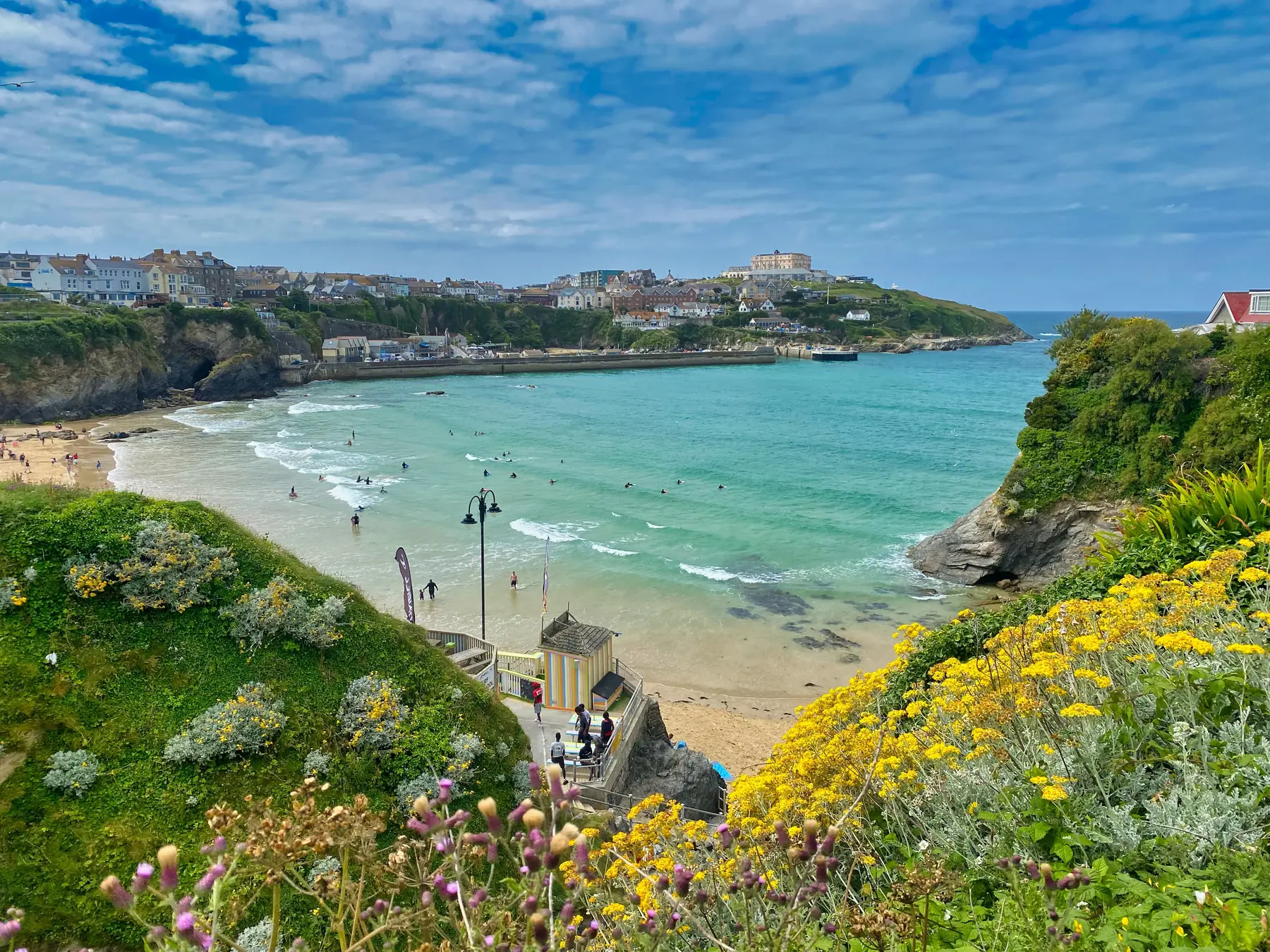
Newquay’s food has changed a great deal in twenty years. The town spent the 1990s and 2000s known for cheap drinking, and the food followed; what has happened since is that the surf economy grew up, the beaches acquired restaurants, and a couple of serious kitchens opened on the headlands. The result is a town where you can eat very well and also very cheaply, sometimes on the same street.
The geography splits four ways: the harbour, Fore Street and the town centre, Fistral and the Headland, and the beach restaurants at Lusty Glaze, Watergate Bay and Crantock.
You are on a working fishing coast and it shows.
Moules and Co on South Quay Hill, by the harbour, is a small seafood restaurant with one of the highest ratings in the town and a menu built around mussels and whatever came in. The Fish House at Fistral, in the International Surfing Centre building above the beach, does fish and seafood with the whole of Fistral Bay in front of it — it is the best-known restaurant in Newquay and it is deservedly busy.
Down at the harbour itself, boats land crab, lobster and line-caught fish, and there are stalls and small places doing the simple version.
Ugly Butterfly at the Headland Hotel on Fistral is the town’s serious restaurant — a Cornish sustainability-focused kitchen from a well-known chef, in a Victorian hotel on the headland with the surf below. It is the place to book for an occasion.
Lewinnick Lodge on Pentire Headland is the other one worth planning around, less formal, with a terrace built on the cliff edge and a view that does a good deal of the work.
HERD on Fore Street does burgers and does them well. Graze on Beacon Road is tapas and wine. Butchers Bistro on Cliff Road is a small bistro with a strong following. Hākari Kitchen is a takeaway with a near-perfect rating and a devoted local audience.
Fore Street and the streets around it also carry the cheaper end thoroughly — pasties, pizza, burritos, fish and chips — and it is genuinely possible to eat well here for very little.
This is the Newquay speciality. Several beaches have proper restaurants on the sand rather than kiosks.
Lusty Glaze has a restaurant and bar on its private cove, reached by the staircase, with live music through the summer. Watergate Bay, five kilometres north-east, has a beach hotel and restaurants directly on the sand. Crantock and Mawgan Porth both have good beach cafés.
Eating on a Cornish beach at seven in the evening in July, with the tide going out and the light going gold, is the thing you will remember.
The town centre has a great many pubs and bars, and in season they are busy and loud. Away from the centre, the Griffin Inn on Cliff Road and the pubs in the surrounding villages — Crantock, St Mawgan, Cubert — are quieter and generally better for a meal.
Cornish beer is well represented, and there is a growing scene of local breweries and distilleries across the county.
Pasties, and the difference between a good one and a bad one is considerable — look for the bakeries rather than the tourist counters. Crab and lobster landed at the harbour. Fish and chips, with the fish landed locally in the better places. Cornish cream tea, jam first. And Cornish ice cream, which is a genuinely different product because of the clotted cream in it.
Booking. July and August are busy, and Boardmasters week in August fills the town completely — the surf competition at Fistral and the festival at Watergate Bay between them bring tens of thousands of people. Book everything well ahead for that week or avoid it deliberately.
Season. A number of the beach restaurants and seasonal places close from October to March. The town-centre restaurants and the hotel dining rooms run year-round.
Getting about. The harbour, Fore Street and Towan are all within a few minutes of each other. Fistral and Pentire are a twenty-minute walk or a short drive; Watergate Bay needs a bus or a car.
Self-catering. A large proportion of Newquay’s visitors self-cater, and the supermarkets and bakeries are stocked accordingly. The farm shops inland are better for produce.
Coffee and a pasty from one of the bakeries in the morning — the difference between a good pasty and a bad one is worth walking for. Lunch on a beach: Lusty Glaze, Watergate Bay or the café at Crantock, depending on where you have ended up. Cornish ice cream in the afternoon, which is a genuinely different product because of the clotted cream. Dinner at the Fish House above Fistral with the sun going into the sea, or Moules and Co by the harbour if you want something smaller. And a last drink somewhere with a view of the water, of which there is no shortage.
Cornwall has become one of the better food regions in Britain over the last twenty years and Newquay benefits from it without always getting the credit. The fishing boats land at the harbour. Cornish beef and lamb come off the farms inland. There is a substantial artisan bakery, cheese, gin and brewing scene across the county, and several of the best producers are within half an hour.
The practical advice is to look past the seafront strip. The restaurants that source properly say so, and the harbour and the headlands are where they are.
Three short trips are worth making. Padstow, seventeen kilometres north, has more good restaurants per head than anywhere else in Cornwall and is the county’s best-known food town — it needs booking well ahead in summer. Watergate Bay, five kilometres north-east, has beach restaurants directly on the sand and is close enough to be an ordinary evening out. And the village pubs at Crantock, St Mawgan, Cubert and Mawgan Porth are quieter, cheaper and frequently better than the town centre.
Perranporth, ten kilometres south-west, has a bar built into the rocks at the end of the beach that is worth the drive on a summer evening for the setting alone.
Better than a surf town’s reputation suggests. The surf and outdoor economy brings a young, health-conscious visitor market, and Newquay’s cafés and casual restaurants cater for it as a matter of course rather than grudgingly — plant-based menus, gluten-free options and proper vegetarian cooking are standard across the town-centre independents and the beach cafés.
The seafood restaurants are, unsurprisingly, the weakest link, though most carry a serious vegetarian option.
Ugly Butterfly at the Headland for an occasion; the Fish House at Fistral for seafood with a view; Moules and Co by the harbour for something smaller.
Lusty Glaze, Watergate Bay, Crantock and Mawgan Porth all have restaurants or good cafés on or above the sand.
Less than the Cornish average. The surf-town economy keeps a substantial cheap-eating layer alive alongside the destination restaurants.
August. It fills the town entirely — plan around it either way.
The harbour, the village pubs at Crantock and St Mawgan, and the takeaways on Fore Street.