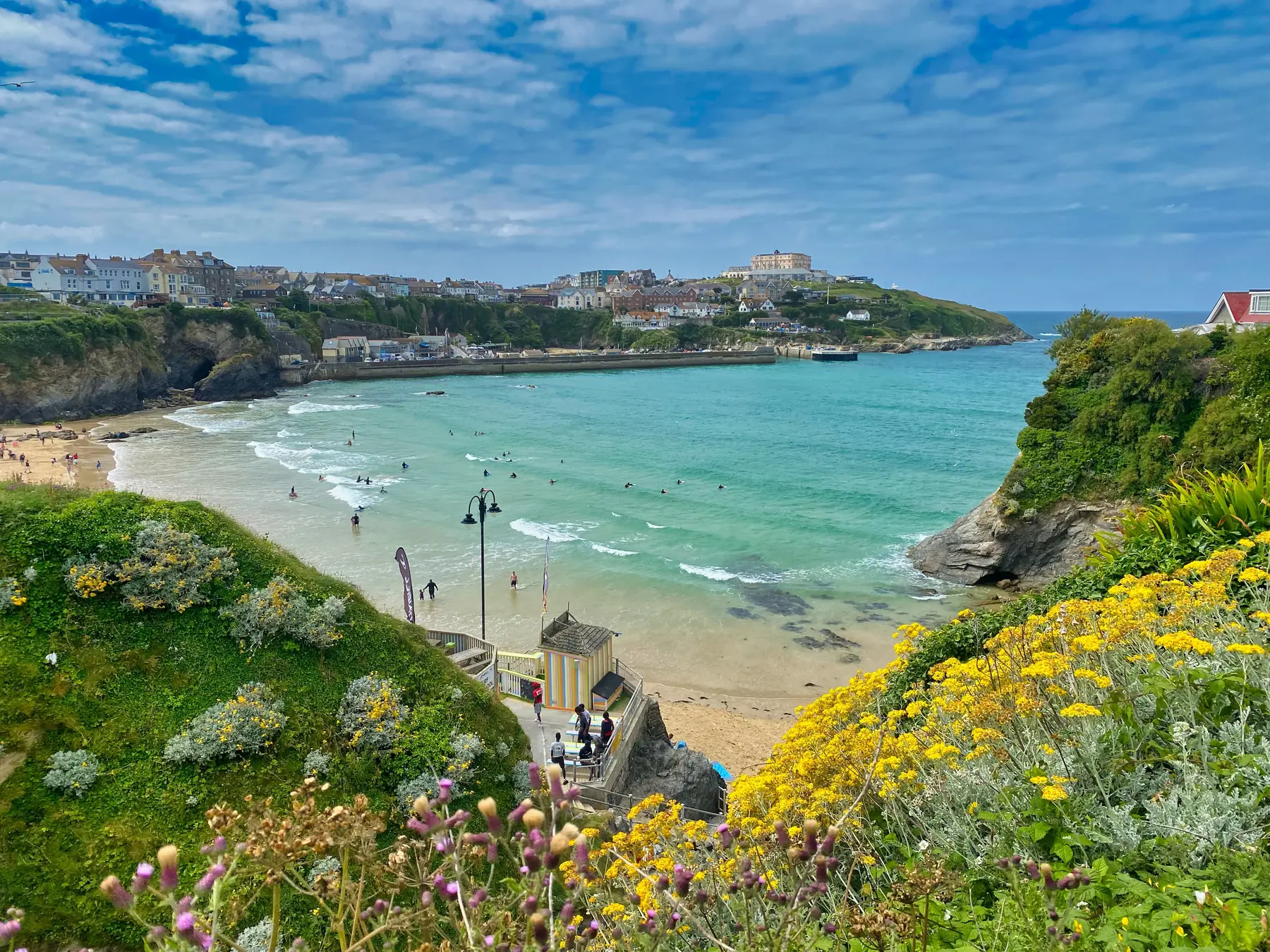
Newquay sits roughly in the middle of Cornwall’s north coast, which makes it a good base for the whole county. Padstow is twenty minutes north, Truro half an hour south, St Ives and the Eden Project both under an hour, and Land’s End about an hour and a half. Cornwall Airport Newquay is on the doorstep.
The caveat is the roads. The A30 is the spine and it queues badly on summer Saturdays; everything off it is lanes with passing places. Distances here are always longer in time than in kilometres.
Seventeen kilometres north, and the obvious first trip. A working fishing port on the Camel estuary that has become the best-known food town in Cornwall, with a harbour full of boats, several restaurants and a National Lobster Hatchery. It is busy — properly busy in August — and it is still worth going.
The Camel Trail runs from Padstow along the old railway line to Wadebridge and on to Bodmin, eighteen miles of level traffic-free path with bike hire at both ends. It is the best family cycle ride in Cornwall.
Across the estuary, the Black Tor ferry crosses to Rock, and beyond it are Polzeath and Daymer Bay.
Eight and ten kilometres north-east. Bedruthan Steps is the line of slate stacks standing in the surf below a National Trust clifftop; Mawgan Porth is a sandy cove with a good beach and a couple of restaurants. Half a day between them.
Thirty-five kilometres north. A fishing village of steep lanes above a harbour, widely known as the setting for a long-running television series, with the Fisherman’s Friends singing on the platt in summer. Small, busy and photogenic.
Tintagel, fifty kilometres north, has the castle on its headland — now reached by a striking bridge — and the Arthurian legend attached to it.
Ten kilometres. Five kilometres of sand at low tide, a beach bar built into the rocks, and dunes behind. It is one of the great Cornish beaches and a straightforward bus ride.
Fifteen kilometres. The heart of the mining coast and a World Heritage Site: Wheal Coates, the engine house standing on the cliff face above the sea, St Agnes Head, Chapel Porth with its beach café, and Trevaunance Cove. The clifftop walk here is the best on this coast.
Twenty-five kilometres south. East Pool Mine has working beam engines; Heartlands and the museums around Pool explain what Cornwall was when it produced a large share of the world’s tin and copper. Unfashionable, and the most interesting history in the county.
Truro, twenty kilometres south, half an hour by bus with services every thirty minutes. Cornwall’s only city and its administrative capital: a Victorian Gothic cathedral, the Royal Cornwall Museum, Georgian streets and the county’s best shopping.
Beyond it, Falmouth and the Roseland Peninsula are an hour, with the great natural harbour of the Carrick Roads and the subtropical gardens on the Helford River.
The Eden Project, forty minutes east near St Austell, is Cornwall’s most-visited attraction — enormous biomes housing a rainforest and a Mediterranean climate in a former china clay pit. Book ahead in the holidays.
The Lost Gardens of Heligan, nearby, is the outdoor counterpart: a Victorian estate garden lost for decades and restored.
Charlestown, with its tall ships in a Georgian harbour, and Mevagissey are on the same run.
St Ives, fifty kilometres west and under an hour, has Tate St Ives, the Barbara Hepworth Museum, Porthmeor beach and the light that brought the artists. It is extremely busy in summer; the park and ride at Lelant and the branch line from St Erth are the sensible ways in.
Beyond it, Penwith — St Michael’s Mount, Land’s End, Porthcurno and the Minack Theatre cut into the cliff — is an hour and a half and a full day.
Bodmin Moor, half an hour east, has Golitha Falls, Brown Willy and Rough Tor, the Hurlers stone circles and Jamaica Inn. It is empty, bleak and completely unlike the coast.
Lanhydrock, near Bodmin, is a Victorian country house with extensive grounds and one of the best sets of below-stairs rooms in Britain.
Better than most of Cornwall. Newquay has its own station three hundred metres from the town centre, at the end of the branch line from Par, with fifteen local services a day Monday to Friday since May 2026. Direct trains from London Paddington run in summer and are thin — a handful a day at most — so outside those months plan on changing at Par, where the main line runs hourly to Paddington in around four and a half hours and to Penzance in an hour.
Buses run to Truro every thirty minutes, to Padstow, Perranporth and St Agnes along the coast, and there is a service east to St Austell, Par and Fowey every two hours.
Cornwall Airport Newquay is a few kilometres from the town. Arrival, including the airport, is covered on the getting here page.
The Padstow day. North to Padstow in the morning for the harbour and the lobster hatchery, hire bikes and ride a stretch of the Camel Trail along the estuary towards Wadebridge, lunch back in the town, and the ferry across to Rock in the afternoon if the tide allows. Level cycling, an estuary and the best-known food town in Cornwall.
The tin coast day. South-west to Perranporth for the beach, on to St Agnes for Trevaunance Cove, then the clifftop walk from St Agnes Head past Wheal Coates to Chapel Porth. Finish with a café at the bottom of the valley. The best scenery within half an hour of Newquay.
The Eden day. East to the Eden Project for the morning and most of the afternoon, with Charlestown’s tall ships or Heligan’s gardens added if there is time. Forty minutes each way and entirely weatherproof at the Eden end.
Two habits fix most Cornish driving problems. Go early — the honeypot car parks at Padstow, St Ives, Bedruthan and Kynance fill by mid-morning in August. And avoid Saturdays on the A30, which is changeover day for the self-catering trade and adds an hour to everything.
Where a train or a bus exists, take it: Truro is half an hour by bus with services every thirty minutes, and the branch line to Par connects to everywhere else in the county.
Cornwall’s two coasts get different weather. Newquay faces the open Atlantic; Falmouth and the south coast, an hour away, sit in the lee of the land and are frequently calm and bright when the north coast is being battered. If the forecast is westerly and wet, going south is a real option rather than a consolation.
Seasonally, the county changes character sharply. May, June and September are the best months here — everything is open, the roads move, and the sea is at its warmest in September. July and August are busy everywhere and gridlocked on Saturdays. Winter empties the coast entirely and is superb for walking and storm watching, though a proportion of the attractions and beach restaurants close.
Padstow and the Camel Trail for a half day, St Agnes and Wheal Coates for the scenery, the Eden Project if it rains.
About forty minutes east near St Austell.
Yes, by bus to Truro and train onwards via St Erth, or by road in under an hour. The branch line into St Ives is worth taking for its own sake.
Yes, though it is very busy in summer. Go early, and take the Camel Trail while you are there.
Not for the town and its beaches. For Bodmin Moor, the Roseland and the smaller coves, it helps a great deal.