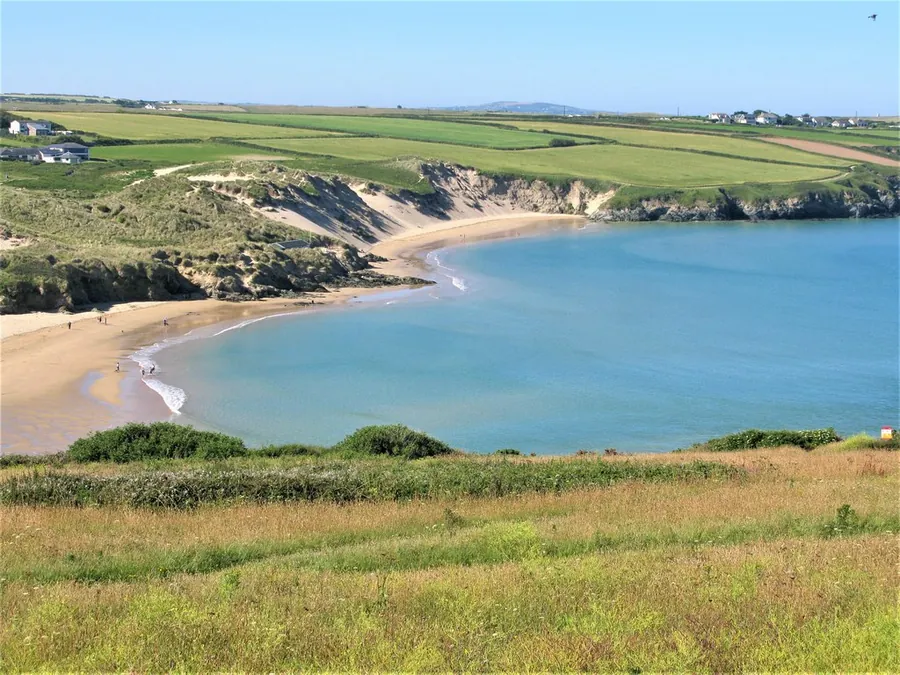
Crantock is a broad sandy beach on the far side of the River Gannel from Newquay, backed by dunes and owned by the National Trust.
It is three kilometres from Newquay as the crow flies and considerably further by road — you have to go round the estuary — which is precisely why it is quieter than the town beaches, and why the people who use it keep going back.
Wide, flat and sandy, with a huge expanse at low tide and a large dune system behind — Rushy Green and the West Pentire dunes, which are a habitat in their own right.
The Gannel runs out across the northern end of the beach into the sea. At low water it is a shallow, warm, slow-moving channel across the sand, and this is what makes Crantock exceptional for small children: from about mid-afternoon on a low tide there is warm, shallow, currentless water to paddle in, well away from the surf.
Families who have worked this out plan their day round the tide table, and they are right to.
At other states of the tide, the Gannel is dangerous.
On a falling or flooding tide the river channel runs fast — fast enough to carry a swimmer or an inflatable out to sea, and it has done. The RNLI and the National Trust both flag it, and it is the single most serious hazard on this beach.
The rules are simple and worth following exactly:
Swim between the flags, in the lifeguarded area, which is deliberately placed away from the river.
Do not swim in the river channel on a moving tide.
No inflatables, anywhere near the Gannel.
Check the tide before you plan the afternoon.
Lifeguards patrol in season. Outside the season there are none, and the river is unchanged.
Parking is the problem. There are two car parks at Crantock — the National Trust one behind the dunes and a farm car park — and both fill early on fine days. Visitors report circling and waiting, and also report that it is worth the wait.
Arrive before ten in season, or come late in the afternoon as the morning crowd leaves.
On foot from Newquay: at low tide it is possible to cross the Gannel on foot at the tidal footbridges and stepping places, which is a lovely walk and completely dependent on the tide — get the timing wrong and you are wading or walking back the long way. Ask locally before attempting it.
By ferry: a small seasonal ferry crosses the Gannel from Newquay.
A beach hut/kiosk — the pasties get specific and enthusiastic mentions.
Toilets.
Surf hire and lessons in season.
There is no pub on the beach — the village of Crantock, ten minutes’ walk inland, has two good ones, the Old Albion and the Cornishman, plus a shop and a fine old church.
Dog-friendly all year, which is unusual for a Cornish beach of this quality and is a large part of why people choose it.
Free beach; parking charged, free to National Trust members.
Access: a walk over the dunes from the car park; not accessible.
Surf: decent Atlantic swell, good for learners and improvers.
Best time: low water in the afternoon, in season.
At low tide, yes — the shallow warm water on the sand flats is excellent. On a moving tide the Gannel river channel runs fast and is genuinely dangerous. Swim between the flags.
Two car parks, both of which fill early on fine days. Arrive before ten or come late afternoon.
Yes, all year — one of the beach’s main attractions.
At low tide, across the Gannel, if you know the crossing and the timing. There is also a seasonal ferry. By road it is a long way round.
No — there is a kiosk on the sand and two pubs in Crantock village, ten minutes’ walk inland.